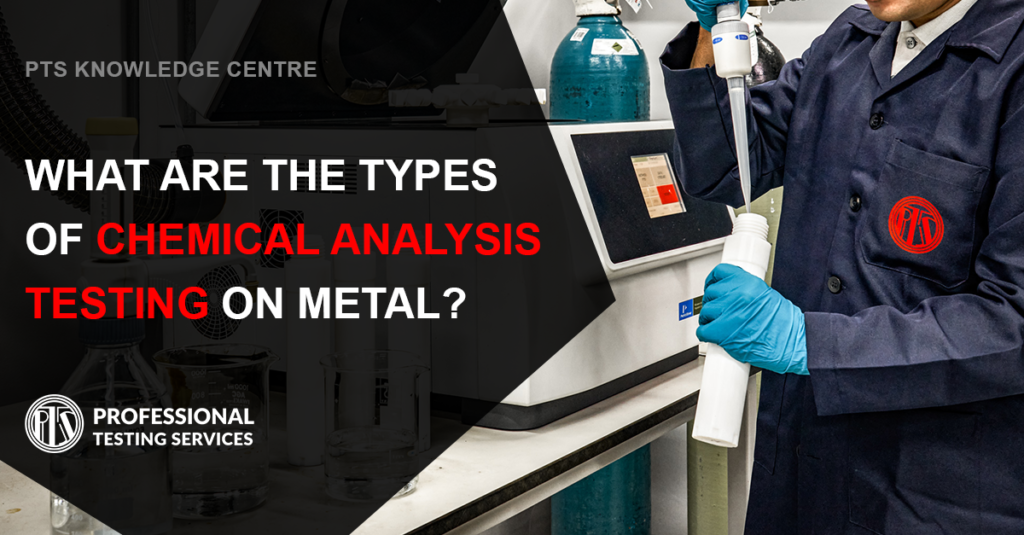
What Is Chemical Analysis?
Chemical analysis is the process of identifying and quantifying the chemical constituents of a material. It is also used to detect the presence of impurities and other substances within the material. This can be very useful for determining the quality and purity of a metal, as well as provide information about how it was processed.
The importance of testing on metal alloys can be seen in various fields such as in construction, engineering, and manufacturing. Metal products are usually tested for their quality before they are sold to consumers or used in production.
What are our 6 Types of Chemical Testing, Characteristics and Benefits?
| TYPES | CHARACTERISTICS | BENEFITS |
| Determination of diffusible hydrogen content | To certify a batch of electrodes as being low in hydrogen content (e.g., 4 mL/100g) | Quantify the amount of hydrogen in welds to avoid hydrogen cracking related failures |
| Determination of metal composition via Spark Optical Spectroscopy (Spark – OES) | To determine the chemical composition of metallic samples | Allows production, quality and R&D personnel to identify and quantify the actual concentration of elements present within the sample |
| Determination of metal composition via Carbon & Sulfur Analyser (Combustion Method) | To determine the concentration of sulphur and carbon contents down to 4 decimal places | Enable personnel to confidently accept or reject a batch of materials |
| Determination of moisture content | To determine accurately the amount of moisture in samples using Karl Fischer technique | Enable users to assess the potential hydrogen available from an electrode covering or flux |
| Determination of metal composition via ONH (Inert Gas Fusion Technique) | To determine the quantitative content of hydrogen, nitrogen, and oxygen in samples. | Simultaneous determination of 3 elements within a single run |
| Determination of metal composition via inductively coupled plasma – Optical Emission Spectrometry (ICP – OES) | To determine the chemical composition of chemicals, metals, plastics, ores, medicine, food and others. | Truly versatile analytical instrument that can service almost any industry (e.g., pharmaceutical, oil & gas, metal, food) |
Contact us to know more on our Chemical Analysis Testing
Our team of experts utilize the best equipment to provide accurate and consistent results. At PTS, we offer several techniques for quantification of your chemical components for a wide variety of materials.
Get in touch with PTS to discover how our chemical analysis services can help you to verify a material certification or to obtain a detailed breakdown of an unknown material of your samples.