Key Takeaway:
EV battery inspection catches internal defects like electrode misalignment, welding faults, and contamination before they become field failures. 2D digital radiography handles fast screening at production volume; 3D computed tomography handles detailed defect sizing and qualification work. Recent high-profile EV recalls trace root cause back to cell-level manufacturing defects, making inspection essential for both production QC and R&D. Local lab access in Singapore reduces turnaround time and protects confidentiality on proprietary cell designs. Our accredited testing laboratory provides both 2D and 3D inspection methods under one roof.
Table of Contents
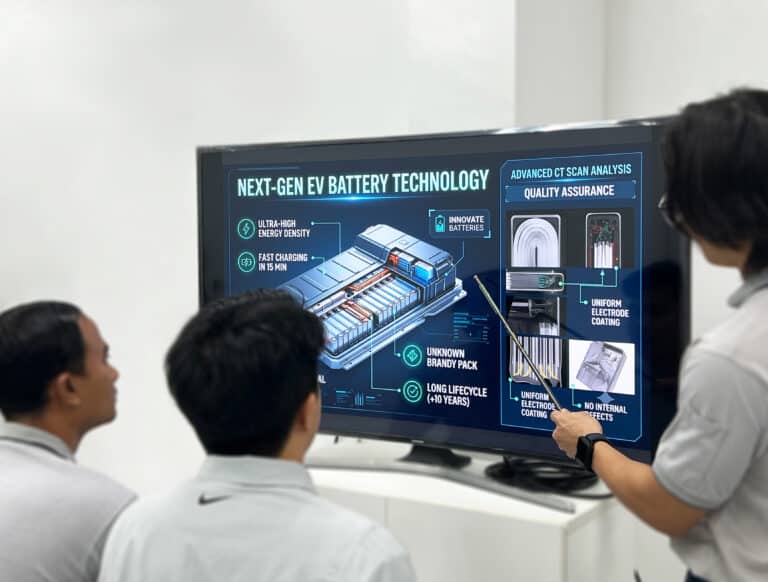
Singapore’s EV adoption is climbing, and so is the volume of battery packs and cells moving through local supply chains, alongside support from A*STAR researchers working on research on new battery technology. Inspecting these batteries for internal defects before they reach a vehicle is a safety baseline every manufacturer or supplier now has to account for as part of the supply chain.
Inspection isn’t limited to production QC either, as research-based inspection is increasingly important as new cell chemistries and materials enter the EV market. Put simply, understanding internal structure during development directly supports safer end products. Below, we cover the steps of battery inspection, the methods involved, and why local lab access matters for EV and electronics firms in the region.
Why EV Battery Inspection Matters
Battery cell defects can lead to thermal runaway, capacity loss, or premature field failure. The failure modes aren’t subtle and can be catastrophic when they happen in service. Worse still, internal short circuits, electrode misalignment, contamination, and welding defects are common failure modes that visual inspection alone can’t catch.
This can be seen in recent EV battery recalls, which have repeatedly traced the root cause back to cell-level manufacturing defects. The 2026 Nissan Leaf recall involved cathode edge damage, causing internal short-circuit risk, whereas the Mercedes-Benz EQB recall pointed to cell robustness issues. Tesla has also issued multiple recalls over battery pack components.
There’s also a clear economic logic to battery inspection. Failures caught at the cell level cost a fraction of failures caught at module, pack, or vehicle level, and a defective cell intercepted in incoming QC saves the cost of a downstream recall. Essentially, investing in non-destructive imaging upstream pays back many times over.
With that, demand for battery inspection services in Singapore is rising in step with EV manufacturing volumes in the region. Local OEMs, suppliers, and R&D teams need imaging capability that catches these defects before they propagate downstream.
What Engineers Look For Inside a Battery
Inspection covers the things that matter for safety and performance:
- Electrode alignment and winding integrity in cylindrical and pouch cells, where misalignment is a leading cause of internal shorts.
- Welding quality at tabs, terminals, and busbar joints. Cold welds, porosity, and incomplete penetration all show up on X-ray.
- Foreign particles or contamination inside the cell. Metal debris from the manufacturing line can cause catastrophic shorts if missed.
- Separator integrity and overhang consistency, particularly at cell edges, where cathode-edge defects or negative anode overhang can develop.
- Pack-level details: busbar welds, module assembly integrity, and thermal management routing.
Engineers need visibility across all of these defect types, and a reliable battery tester in Singapore can ideally cover all of them in one inspection workflow.
Inspection Methods Used
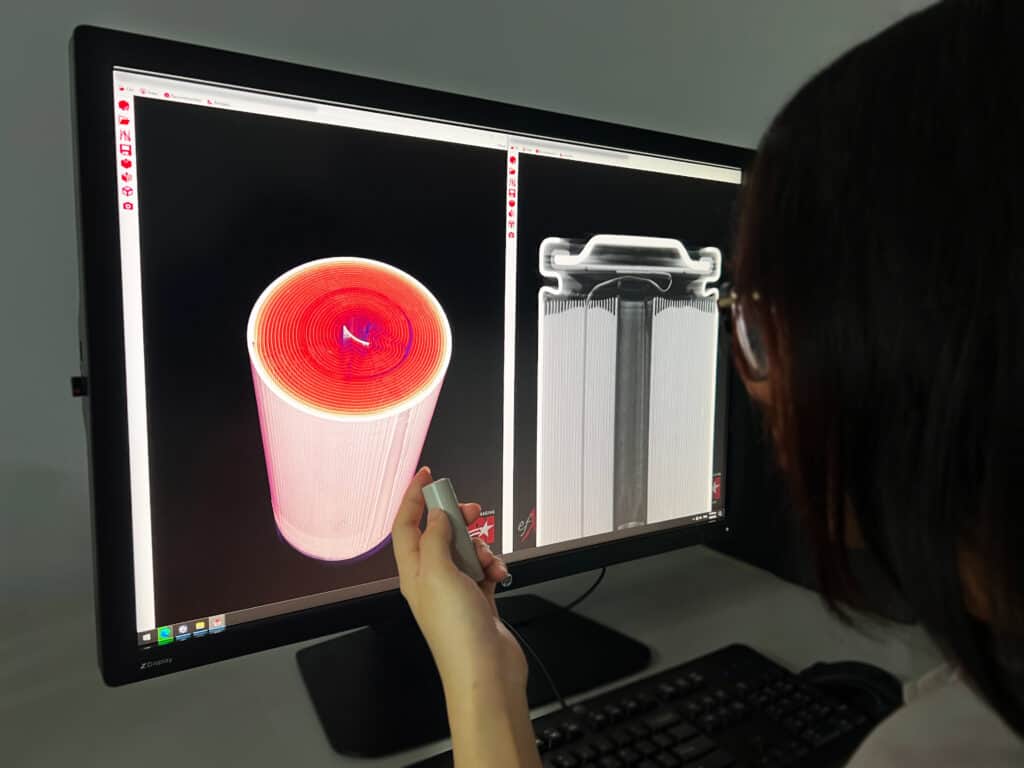
In battery inspection, two complementary methods do the heavy lifting:
- 2D Digital Radiography: fast screening for misalignment, gross defects, and welding issues at volume. Best for incoming QC and production-line screening.
- 3D Computed Tomography: full internal geometry, defect sizing, and slice-by-slice review of cells and packs. Best for confirmed defects, failure investigations, or qualification samples.
In practice, the two are often combined. 2D handles the screening pass, while 3D handles the detailed look at flagged units, qualification cycles, or R&D samples. Both methods produce reports that support production QC and supplier accountability.
For Singapore-based EV and electronics firms, PTS is one such lab that offers 3D scanning services in Singapore that cover full pack-level inspection in addition to individual cells.
Why Local Lab Access Matters for Singapore's EV Ecosystem
Shipping battery samples overseas adds time and complexity to QA workflows. Having local lab access changes the equation as you get:
- Faster turnaround: results in days rather than weeks
- Easier engineer-to-lab collaboration on qualification and failure investigations
- Confidentiality: proprietary cell designs and pre-production samples stay in-region, with cleaner handling protocols
- Supports both EV OEMs and electronics suppliers feeding into battery production
The growing density of EV-related operations in Singapore makes regional inspection capacity practical and important. A capable EV battery testing lab in Singapore reduces friction at every stage of the development and production cycle, and PTS is one that offers industrial CT scanning services that support both production QC and R&D contexts for EV and electronics firms.
How We Handle Battery Inspection at PTS
At PTS, our laboratory is accredited to ISO/IEC 17025:2017 by SAC-SINGLAS, covering scheduled mechanical, chemical, metallurgical, and NDT services. For battery work, we offer 2D digital radiography and 3D CT as a service alongside it, with SINGLAS scope expansion planned for 2027.
With us, engineers can scope inspections from individual cells to full pack assemblies, and we provide reports tailored for engineering review, QA documentation, and supplier discussions. Our broader Singapore testing services cover the full NDT and materials testing range for EV and electronics work.
Start Your Battery Inspection With Our Team
With EV adoption rates steadily climbing, having proper battery inspection processes ensures internal defects can be caught before they become field failures, recalls, or worse. Methodology-wise, 2D and 3D X-ray together give the clearest picture of what’s happening inside the cell or pack before it ever reaches a vehicle, especially when led by a trusted EV battery testing lab in Singapore.
References:
ISO/IEC 17025:2017 – General requirements for the competence of testing and calibration laboratories. Retrieved 28 June 2026, from https://www.iso.org/standard/66912.html
Singapore Accreditation Council (SAC-SINGLAS) – Laboratory Accreditation. Retrieved 28 June 2026, from https://www.sac-accreditation.gov.sg/
Frequently Asked Questions About EV Battery Inspection in Singapore
EV battery inspection checks for internal defects that visual inspection can’t catch: electrode alignment and winding integrity in cells, welding quality at tabs and busbars, foreign particles or contamination inside the cell, separator integrity, and pack-level assembly issues. These defects can lead to thermal runaway, capacity loss, or premature field failure if missed during production.
Yes. Both 2D digital radiography and 3D computed tomography are non-destructive methods. The cell stays intact throughout the inspection and can be used for further testing, returned to assembly if it passes, or preserved as evidence in disputed failures or warranty claims. No sectioning, no contamination of the sample.
Yes. At PTS, we can scope inspections from individual battery cells (cylindrical, pouch, or prismatic formats) all the way up to full pack assemblies, including busbar welds, module-level assembly integrity, and thermal management routing. The inspection scope is matched to the project’s specific QA or qualification needs.
Local lab access cuts turnaround time from weeks to days, makes engineer-to-lab collaboration easier during qualification or failure investigations, and keeps proprietary cell designs and pre-production samples in-region for cleaner confidentiality handling. For the growing density of EV operations in Singapore, regional inspection capacity reduces friction at every stage of development and production.
CONTACT PTSPL TODAY
Reach out to PTS today for battery inspection backed by industrial CT scanning services and 2D digital radiography in Singapore. Our accredited testing laboratory delivers 3D scanning services in Singapore for EV battery and electronics firms across the region. Send us your sample details, and we’ll come back to you with the right inspection scope.