Key Takeaway:
- Singapore’s accredited test labs give Malaysian manufacturers access to advanced CT inspection capabilities for high-stakes parts that demand tight tolerances.
- 3D scanning via industrial CT covers full internal and external dimensional verification, defect detection, assembly verification, and reverse engineering from physical parts.
- Use cases include first article inspection, safety-critical components, parts for global supply chains requiring ILAC-recognised results, and complex internal geometries.
- SAC-SINGLAS accreditation of the testing laboratory carries international recognition through ILAC, supporting OEM and end-client requirements on results from scheduled test methods.
- Typical turnaround sits at 2–5 working days, depending on part complexity, sample volume, and inspection scope.
- PTSPL is a SAC-SINGLAS accredited testing laboratory offering 3D scanning services in Singapore via industrial CT, with reverse engineering output as STL models.
Table of Contents
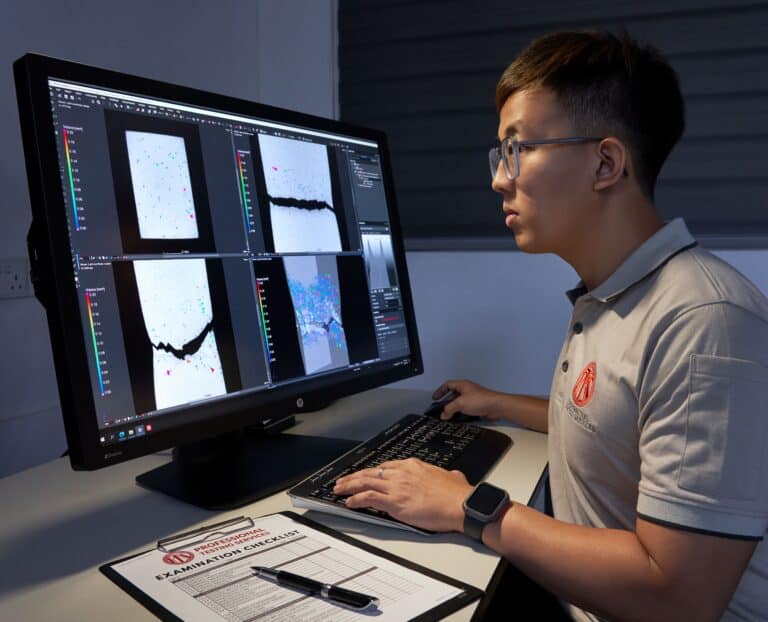
For Malaysian manufacturers handling high-stakes parts, the inspection options closest to home don’t always meet the resolution or accreditation that customers expect. Tight-tolerance components, safety-critical hardware, and parts destined for international supply chains often require verification beyond what standard in-house equipment can provide.
A Tier-1 automotive supplier validating a new casting, an aerospace subcontractor confirming internal weld integrity, or a medical device manufacturer chasing porosity below 50 microns all run into the same wall. Fortunately, Singapore’s accredited test labs sit a short logistics window away and offer the technical depth to fill that gap.
We’ll cover how 3D scanning for part inspection in Singapore labs supports Malaysian manufacturers through industrial CT for dimensional verification, defect detection, and reverse engineering.
Why Malaysian Manufacturers Look to Singapore
For Malaysian quality and engineering teams, there are several factors that push the need for inspection across the causeway, especially when demands climb beyond what existing equipment can confirm:
- Access to PTS, a SAC-SINGLAS-accredited testing laboratory with 3D CT capability that carries international recognition through ILAC mutual recognition arrangements
- Higher resolution capabilities for tight-tolerance parts where micron-level deviations matter
- Established QA infrastructure recognised by global OEMs and end-clients
- Geographic proximity that keeps logistics and turnaround manageable, without shipping parts to Europe or the US
- Optimised CT scan parameters that balance resolution with throughput for project schedules
The accreditation point is the one that tends to settle the decision. Singapore’s SAC-SINGLAS scheme operates under the ILAC Mutual Recognition Arrangement, which means an inspection report carries the same weight in Germany, Japan, or the US as it does locally.
For Malaysian suppliers in OEM-driven supply chains, this international recognition settles most audit questions before it gets asked.
What 3D Scanning for Part Inspection Covers
Several standards govern fracture toughness testing for offshore work. Project specifications usually call out one or more of the following:
- ISO 15653: Common baseline for fracture toughness testing of weldments
- ISO 12135: Methods for determining fracture toughness in homogeneous metallic materials, commonly applied to base metals
- BS 7448: British standard, frequently referenced in offshore specs and historic project documents
- ASTM E1820: Widely used on American-spec projects and refinery-related work
- DNV-ST-F101: Submarine pipeline systems standard with specific CTOD requirements for girth welds and structural elements
With any project, confirm which standard the project specification calls out before any test planning begins, as the acceptance criteria, specimen geometry, and reporting formats all flow from that decision.
What Is the Procedure of CTOD Testing?
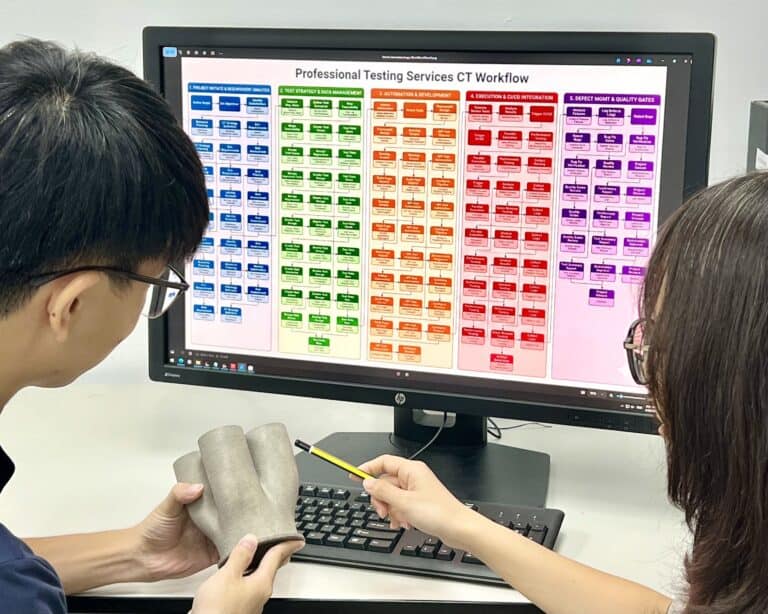
Industrial CT goes well beyond surface measurement. By capturing the entire volume of a part in a single scan, it makes the internal structure as accessible as the outer geometry. That opens up four core inspection use cases.
Dimensional Verification
- Full internal and external geometry acquisition and analysis via CT
- Compare actual part dimensions against the customer’s CAD model or 2D drawings
- Identify wall thickness variations, warpage, and tolerance deviations across the volume
- Measure features that are impossible to reach with traditional CMM probes or callipers
Defect Detection
- Detect internal voids, porosity, cracks, and inclusions invisible to surface inspection
- Locate defects precisely within the 3D volume, with size and exact spatial position quantified
- Assess defect distribution across a part or batch for process control insights
- Generate qualitative and quantitative data that supports the validation of process improvements
Assembly & Fit Verification
- Inspect multi-component assemblies without disassembly
- Verify internal component alignment, seating, and clearances
- Detect foreign object debris or missing internal features before parts ship to the customer
Reverse Engineering
- Our 3D reverse engineering services generate STL models from physical parts where no existing drawings are available
- Useful for legacy components, discontinued parts, or virtual teardowns of commercially available products
- Accurate geometry capture supports tooling recreation, design reference, or comparison studies
- Volumetric data from CT imaging feeds higher-fidelity Finite Element Analysis (FEA) inputs, improving the predictive accuracy of simulations
Within broader dimensional SAC-SINGLAS accredited metrology contexts, CT sits among the techniques used to verify part geometry against design intent, though it remains a non-contact, full-volume method rather than a point-probe approach like the traditional Coordinate Measuring Machine (CMM).
When to Use Singapore Labs
Not every part needs to cross the border for inspection. The decision for 3D scanning for part inspection in Singapore usually comes down to whether the result has to satisfy a third party, or whether the geometry sits beyond what local equipment can confirm.
First article inspection is one of the clearest triggers. Validating a new part before committing to full production benefits from a result that international clients will recognise without question, particularly when the part feeds an export-driven supply chain. The same logic applies to high-value or safety-critical components, where the cost of an undetected defect runs far higher than the cost of accredited verification.
Global supply chain requirements are another good reason. End-clients and OEMs increasingly specify ILAC-recognised accreditation or independent third-party verification in their supplier contracts, and meeting those specifications can be a deciding factor in retaining the work.
Beyond accreditation, capability is the other common driver. Complex internal geometries that surface inspection cannot confirm, parts requiring resolution beyond in-house CMM or callipers, and components larger than existing equipment can handle all point in the same direction. With that, Singapore CT facilities sit ready for those jobs.
What to Expect: Process and Turnaround
The typical workflow from first enquiry to final report runs through four stages:
1. Ship parts to the Singapore lab, with logistics guidance available where needed
2. Define the inspection scope: dimensional verification, defect detection, CAD comparison, or porosity distribution analysis
3. CT scanning, data processing, and analysis against the agreed criteria
4. Receive a detailed report with images, measurements, and a pass/fail assessment against the supplied reference
Typical turnaround sits at 2–5 working days, depending on part complexity, sample volume, and the depth of analysis specified. But if you have larger batches or projects with multiple inspection criteria, these are scoped during the enquiry stage to keep timelines realistic.
Close the Inspection Gap with Accredited Labs in Singapore
For Malaysian manufacturers handling tight-tolerance or safety-critical parts, opting for industrial 3D CT inspection at an accredited Singapore testing laboratory is a practical, accessible route to getting high-precision verification without the cost or lead time of sending parts further abroad. What’s more, a single scan delivers internal geometry, defect data, and reverse-engineered models in one pass.
Cue PTSPL, where we operate an SAC-SINGLAS-accredited testing laboratory in Singapore, with ISO/IEC 17025:2017 accreditation covering mechanical, chemical, metallurgical, and NDT services. Our 3D CT facility supports Malaysian manufacturers on first article inspection, defect investigation, reverse engineering, and failure analysis, backed by the same lab infrastructure and technical depth that supports our accredited testing work.
References:
1. Singapore Accreditation Council (SAC) – SINGLAS. Retrieved 29 April 2026, from https://www.sac-accreditation.gov.sg/
2. ILAC Mutual Recognition Arrangement. Retrieved 29 April 2026, from https://ilac.org/ilac-mra-and-signatories/
Frequently Asked Questions About 3D Scanning for Part Inspection in Singapore
Most projects clear the lab within 2–5 working days from receipt of the part. Complexity, sample volume, and the depth of analysis required all influence the schedule, and the scope is confirmed at the enquiry stage to keep expectations aligned.
Standard output includes inspection reports with images, dimensional measurements, and defect maps. For reverse engineering work, geometry is delivered as STL models suitable for visualisation, comparison, or downstream simulation work. Raw datasets in DICOM, VG, or other proprietary visualiser formats are available upon request.
CT and CMM serve different roles. CMM remains highly accurate for accessible external features, while CT captures internal geometry and defects that contact probes cannot reach. Many projects use the two together, with CT covering features outside CMM’s reach.
Get in Touch with PTSPL today
If your team is evaluating 3D scanning for part inspection in Singapore for an upcoming project, explore our 3D scanning services in Singapore today. You can also reach out to our specialists to discuss part requirements, scope, and turnaround.