Key Takeaway:
- CTOD testing verifies that base metal, weld metal, and the heat-affected zone can tolerate flaws without brittle fracture under offshore service conditions.
- Project specifications, classification societies, and end-clients commonly mandate CTOD for offshore platforms, subsea pipelines, and jacket structures.
- Key standards for subsea pipelines include ISO 15653, ISO 12135, BS 7448, ASTM E1820, and DNV-ST-F101.
- The procedure covers specimen extraction, fatigue pre-cracking, low-temperature test execution, fracture measurement, and reporting against the acceptance criteria.
- Choosing a CTOD lab comes down to ISO/IEC 17025 accreditation, low-temperature capacity, classification society experience, and technical support.
- PTS specialises in CTOD sample preparation for mass testing, with a pre-cracking method that shortens lead time on tight project schedules.
Table of Contents
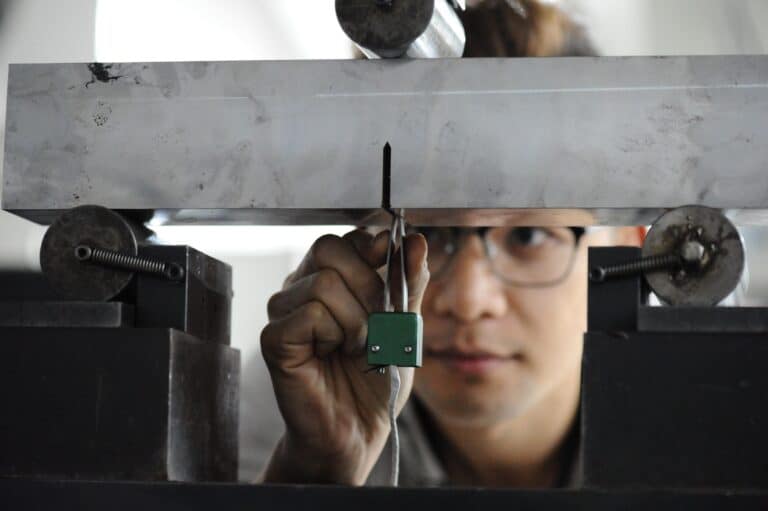
Offshore structures operate under conditions that few onshore assets ever face, where sub-zero seawater, cyclic wave loading, sour service environments, and decades-long design lives all sit on top of the same welded steel sections. Material toughness has to hold up against every one of those factors, and that’s where CTOD testing in offshore structures earns its place in the qualification chain.
In this guide, we cover why the CTOD test is required for offshore applications, the standards that govern it, and what to look for in a CTOD testing laboratory that Singapore teams can rely on for project-critical work.
Why CTOD Matters for Offshore
Offshore platforms, subsea pipelines, and jacket structures sit in environments where fracture is unacceptable. Repair costs run high, downtime is measured in millions per day, and safety consequences are severe. As conventional toughness data alone doesn’t always answer the right question for these assets, this is where CTOD offshore testing comes in.
The Charpy impact test confirms general toughness for production QC, but it doesn’t quantify how a material behaves once a defect is already present. CTOD does so by measuring how far a crack tip opens before unstable propagation, thereby verifying that the base metal, weld metal, and the heat-affected zone (HAZ) can tolerate realistic flaws without brittle fracture at service temperature.
Beyond that, why CTOD testing is required is because project specifications, classification societies (DNV, ABS, Lloyd’s Register), and end-clients commonly mandate CTOD for:
- Girth welds on subsea pipelines and risers
- Critical structural welds on platform jackets and topsides
- Pressure-retaining welds in process equipment
- Repair welds on existing offshore assets
Key Standards for Offshore CTOD Testing
Several standards govern fracture toughness testing for offshore work. Project specifications usually call out one or more of the following:
- ISO 15653: Common baseline for fracture toughness testing of weldments
- ISO 12135: Methods for determining fracture toughness in homogeneous metallic materials, commonly applied to base metals
- BS 7448: British standard, frequently referenced in offshore specs and historic project documents
- ASTM E1820: Widely used on American-spec projects and refinery-related work
- DNV-ST-F101: Submarine pipeline systems standard with specific CTOD requirements for girth welds and structural elements
With any project, confirm which standard the project specification calls out before any test planning begins, as the acceptance criteria, specimen geometry, and reporting formats all flow from that decision.
What Is the Procedure of CTOD Testing?
For what the procedure of a CTOD test is, the workflow follows five stages:
Step 1. Specimen Extraction & Preparation
Specimens are taken from parent metal, weld metal, or HAZ, depending on project requirements. The notch location is specified by the standard or client spec, typically along the weld centreline, fusion line, or a defined HAZ position. Specimens will be notched and, for weldments, compressed before pre-cracking to relieve residual stress and ensure a straight crack front.
Specimen geometry here follows ISO 15653, ISO 12135, BS 7448, or ASTM E1820.
Step 2. Pre-Cracking
Fatigue pre-cracking creates a sharp crack tip at the machined notch, with the crack length controlled within standard tolerances. This step is critical, as improper pre-cracking invalidates the result regardless of how cleanly the rest of the test runs.
Step 3. Test Execution
The specimen is cooled to the specified test temperature, often at or below the minimum design temperature. Load is applied under a controlled displacement rate, with crack tip opening measured throughout loading via a clip gauge.
Step 4. Fracture & Measurement
Loading continues until fracture or maximum load is reached. The CTOD value is then calculated at the point of fracture, maximum load, or pop-in, depending on the standard applied.
Step 5. Reporting
The CTOD value is reported against project acceptance criteria, usually expressed as δ (delta), while other characteristic values such as KIc, J-integral, and R-curve are available on request. Reports include the load-displacement curve, fracture surface assessment, and confirmed test temperature. For weldments tested under ISO 15653, pre- and post-test metallography images are included.
What to Look for in a CTOD Testing Lab
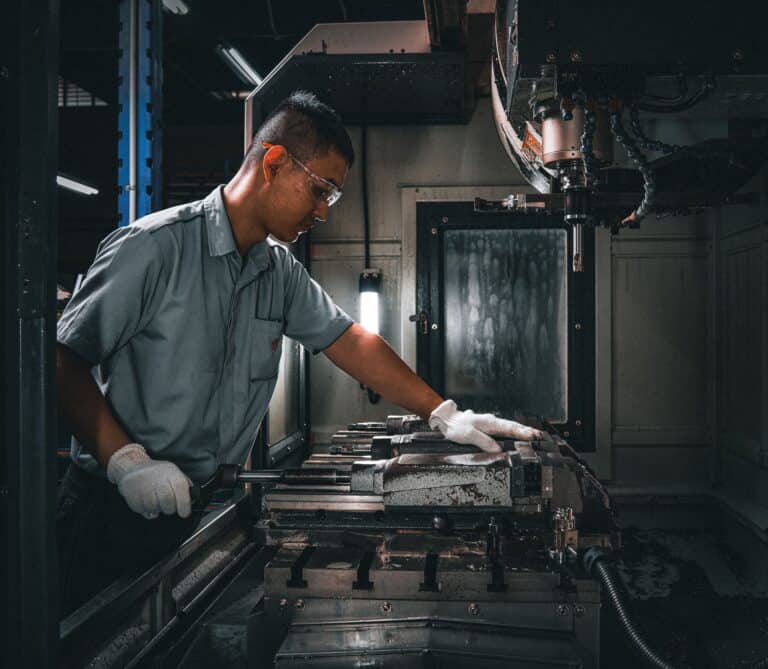
A CTOD result is only as reliable as the lab producing it. There are several important criteria to consider when evaluating a crack tip opening displacement test facility for offshore work:
- ISO/IEC 17025 accreditation for the specific test method, so results are recognised internationally through ILAC
- Experience with offshore project specs and classification society documentation requirements
- Capacity for low-temperature testing, often down to -40°C or lower for arctic and deepwater specs
- Technical support on result interpretation and aligning acceptance criteria with the governing code
- Throughput for mass CTOD programmes, particularly where pipeline girth weld qualifications or large structural batches need to clear the lab on a fixed project schedule
On that last point, PTS specialises in CTOD sample preparation for high-volume offshore work. Our pre-cracking method uses specialised equipment that speeds up one of the most time-consuming stages of the test cycle, which keeps lead times tight on mass CTOD programmes without any compromise on standard compliance.
Build Confidence in Your Offshore Material Integrity with CTOD Testing
For offshore structures, CTOD testing is a non-negotiable step to confirm that welds and base metal can withstand real-world service conditions. Even so, getting the procedure right, the standard right, and the lab right are the three pieces of CTOD testing in offshore structures that need to align before a result holds up under classification society review.
At PTSPL, we have supported the offshore, marine, and structural sector across Southeast Asia since 1985 with crack tip opening displacement testing and more. Our Singapore facility is ISO/IEC 17025:2017 accredited, with the equipment, low-temperature capacity, and technical depth to handle CTOD programmes from single-specimen qualifications to large project batches. Together with our regional offices, we keep coordination close to where the fabrication is happening for Malaysian, Indonesian, and Bruneian project teams.
References:
- DNV-ST-F101 Submarine pipeline systems. Retrieved 29 April 2026, from https://www.dnv.com/energy/standards-guidelines/dnv-st-f101-submarine-pipeline-systems/
- ASTM E1820-23b Standard Test Method for Measurement of Fracture Toughness. Retrieved 29 April 2026, from https://www.astm.org/e1820-23b.html
Frequently Asked Questions About CTOD Testing in Offshore Structures
Offshore assets operate at low temperatures with cyclic loading and corrosive exposure, all conditions that raise the risk of brittle fracture. CTOD testing confirms that welds, base metal, and the HAZ can
The most commonly referenced standards are ISO 15653 for weldments, ISO 12135 for base metal, BS 7448, and ASTM E1820. For subsea pipelines specifically, DNV-ST-F101 sets additional requirements for girth welds and structural elements.
A specimen is extracted, machined, and fatigue pre-cracked, then loaded at a defined low temperature while the crack-tip opening is measured using a clip gauge. The test runs to fracture or to the maximum load, and the resulting CTOD value is reported against the project acceptance criteria.
Test temperatures match or sit below the minimum design temperature for the asset. Offshore specs commonly call for testing at -10°C, -20°C, or lower, with arctic and deepwater projects reaching -40°C or below.
Lead time depends on specimen quantity, pre-cracking volume, and reporting depth. Mass CTOD programmes for pipeline girth welds can run for several weeks, though specialised pre-cracking methods significantly shorten that window.
Get in Touch with PTSPL today
If you have an offshore project requiring CTOD, get in touch with our team to discuss specifications, timelines, and acceptance criteria. Explore our full range of Singapore testing services for fracture toughness, mechanical, and weld qualification work.