Key Takeaway:
- The crack tip opening displacement test measures how far a crack tip opens under load before fracture, quantifying a material’s resistance to brittle crack propagation in the presence of a flaw.
- CTOD test acceptance criteria are not universal. Values are set based on design temperature, material thickness, stress levels, and flaw-tolerance assumptions, and are expressed as the minimum CTOD (mm) at a specified test temperature.
- Indicative minimum values range from 0.15–0.25 mm for subsea/pipeline welds and 0.20–0.30 mm for offshore structural welds, but project-specific requirements always take precedence.
- Key governing standards include ISO 15653 (welds), BS ISO 12135 (parent metals), BS 7448, and ASTM E1820. In Singapore and the wider region, ISO 15653 and ISO 12135 are the common baselines.
- CTOD specimens should cover base metal, weld metal, and HAZ. Missing HAZ testing is one of the most common qualification gaps.
- Factors, including test temperature, specimen orientation, notch location, and PWHT status, all influence CTOD results and must align with actual fabrication and service conditions.
Table of Contents

Offshore structures and marine vessels don’t fail gradually. When a brittle fracture initiates, it propagates fast, and the consequences are rarely recoverable. For this reason, the materials you use in these environments need to be verified as able to tolerate existing flaws under operating conditions before they go into service.
The crack tip opening displacement test measures exactly that: how far a crack tip can open under controlled load before fracture occurs, quantifying a material’s resistance to brittle crack propagation. Globally, meeting the right CTOD test acceptance criteria for the project’s service conditions is a critical engineering safeguard that sits between structural adequacy and failure in service.
In this guide, we’ll cover the crack tip opening displacement acceptance criteria commonly used in oil & gas and marine construction: which standards govern them, the values typically required, and the factors
What Is CTOD Testing?
CTOD (Crack Tip Opening Displacement) is a fracture mechanics test that quantifies how much a crack tip opens under load before fracture. Unlike a standard tensile or impact test, it starts with the assumption that a flaw is already present in the material. Its purpose is to determine whether a material can tolerate realistic defects without catastrophic failure under service conditions.
Crack tip opening displacement tests are primarily applied to steel base metal, weld metal, and heat-affected zones (HAZ) adjacent to welds. The output is a CTOD value measured in millimetres, reported at a specified test temperature. A higher value indicates greater tolerance to crack propagation, while a lower value signals higher susceptibility to brittle fracture under the same conditions.
Why a CTOD Test Is Required in Critical Industries
Understanding why CTOD testing is required and mandated in oil & gas and marine applications starts with the service conditions these structures face. Standard Charpy impact testing confirms general toughness for production QC. But for critical structural welds, that data alone is often insufficient, particularly where pre-existing flaws must be tolerated, and the project specification requires fracture mechanics-based assessments.
Oil & Gas
Offshore platforms, subsea pipelines, and pressure vessels operate under conditions that combine extreme mechanical loads, low ambient temperatures, and corrosive environments. Seabed temperatures can drop to near-freezing levels, significantly increasing the risk of brittle fracture in structural steels. Weld integrity is critical throughout, and the HAZ is frequently the weakest region in the weld cross-section.
Project specifications for oil & gas work often mandate CTOD testing for girth welds, critical structural joints, and repair welds. Classification society requirements and end-client engineering specs routinely include it as a minimum qualification requirement, particularly for subsea and high-consequence applications.
Marine Construction
Ship hulls, offshore wind foundations, and port infrastructure operate under cyclic loading and prolonged seawater exposure. Fatigue crack initiation is a known failure mode in these environments, and the crack-tip opening displacement acceptance criteria used must ensure that structures can tolerate flaws without sudden failure under dynamic loading.
Classification societies, including DNV, Lloyd’s Register, and ABS, specify CTOD requirements for offshore structures, ship structures, low-temperature service applications, and critical weld joints. Fitness-for-service assessments following in-service inspection findings also typically require CTOD data as input to fracture mechanics calculations.
Key Standards Governing CTOD Testing
Project specifications determine which standard applies, but the following are consistently referenced across oil & gas and marine work, including under the ISO 15653 Singapore standard framework and internationally:
- ISO 15653: Specifies CTOD testing methods for welds in metallic materials. The ISO 15653 standard complements ISO 12135 and is widely referenced for oil & gas and marine projects, specifically for weld metals.
- BS ISO 12135: Covers quasistatic fracture toughness testing for homogeneous metallic materials, applicable to base or parent metals.
- BS 7448: British standard covering fracture mechanics toughness tests across Parts 1–4, including various specimen types and weld applications.
- ASTM E1820: American standard for fracture toughness measurement, including CTOD; referenced for projects following American-spec requirements.
For pipeline-specific work, DNV-OS-F101 / DNV-ST-F101 and DNV-OS-C401 set additional CTOD requirements for girth welds and structural elements. EEMUA Publication 158, widely referenced in refineries and petrochemical plants, points to ISO 12135 and ASTM E1820 as the relevant test methods.
Note: In Singapore and the wider regional context, ISO 15653 and ISO 12135 are the common baselines. Always confirm which standard the project specification calls out before beginning test planning.
CTOD Acceptance Criteria: What's Typically Required?
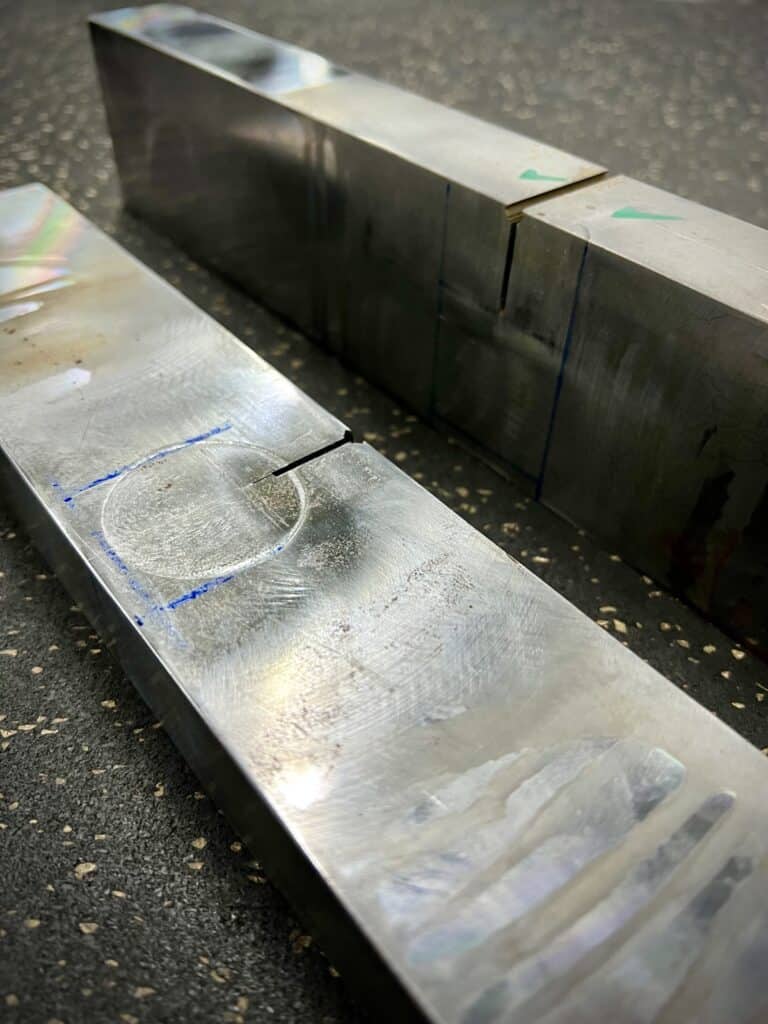
This is where engineering teams most often need clarity. CTOD test acceptance criteria are not universal values, as they’re defined based on design conditions and the outcomes of project-specific engineering assessments.
How Criteria Are Set
Acceptance values are driven by the design temperature, material thickness, stress levels, and flaw-tolerance assumptions derived from an engineering critical assessment (ECA). The result is typically expressed as a minimum CTOD value in millimetres at a test temperature set at or below the minimum design temperature, commonly ranging from −10°C to −40°C for offshore and North Sea applications.
Indicative Values by Application
The following ranges reflect common industry practice, though project-specific requirements always take precedence:
- Oil & gas subsea and pipeline welds: Minimum CTOD typically ranges from 0.15 to 0.25 mm at the design temperature.
- Offshore structural welds: Values generally range from 0.20 to 0.30 mm, depending on classification society requirements and the specific structural application.
- Marine and shipbuilding: Varies by class society rules: DNV, Lloyd’s, and ABS each maintain their own CTOD requirements aligned with structural rules for the relevant service category.
Note: These are indicative ranges only. Acceptance criteria can vary significantly based on engineering criticality assessments for the specific structure and application.
What Gets Tested
CTOD qualification typically covers three material locations:
- Base/parent metal
- Weld metal
- Heat-affected zone (HAZ), often the most critical, as microstructural changes from welding heat cycles can reduce local toughness relative to the parent material
It’s important to note that criteria and requirements are project-specific, so confirm before specifying the test setup. If you’re unsure about the criteria or require a customised test setup, consult the PTS team for guidance.
Factors That Influence CTOD Results
Several variables can affect the outcome for interpreting CTOD data, or specifying tests that will produce valid, project-relevant results:
- Test temperature: Lower temperatures generally produce lower CTOD values. The test temperature must match or exceed the conservatism required by the design conditions.
- Specimen orientation: Through-thickness versus surface notch orientation affects results, particularly for materials with directional microstructures or significant thickness.
- Notch location: Testing at the weld centreline, fusion line, or HAZ can produce meaningfully different toughness values. The notch position must correspond to the actual region of concern for the application.
- Material condition: Post-weld heat treatment (PWHT) status affects toughness. Test specimens should reflect the actual fabricated condition of the component being qualified.
Common Issues in CTOD Qualification
A few recurring problems can consistently cause failed qualifications or retests to be needed:
- Misaligned test temperature: The specified test temperature doesn’t reflect actual service conditions, producing results that can’t be applied to the real design scenario.
- Incomplete specimen coverage: Testing weld metal only, without including HAZ specimens, despite HAZ being statistically the more likely fracture initiation site in welded structures.
- Insufficient specimen count: Most standards and project specs require multiple test specimens per location to produce statistically valid data. Underspecifying this creates inadequate datasets.
- Procedure mismatch: Fabrication conditions during qualification differ from those in production. The qualification data then doesn’t represent the actual production weld performance.
Meet CTOD Acceptance Criteria with PTS's Testing Services
CTOD test acceptance criteria are engineered safeguards built around the real service conditions of critical structures. For engineering teams, having a clear understanding of what’s required and why helps you specify the right tests at the right temperatures and cover the right material locations before moving to fabrication or project approval.
As an accredited test laboratory operating since 1985, PTS provides crack-tip opening displacement test services in accordance with ISO 15653, ISO 12135, BS 7448, and ASTM E1820. With our ISO/IEC 17025:2017-accredited laboratories in Singapore, Malaysia, and Indonesia, we support oil & gas, marine, and structural projects across the region with precise testing, reliable results, and fast turnaround.
References:
EEMUA Publication 158 Digital. Retrieved on 18th March 2026 from https://www.eemua.org/products/publications/digital/eemua-publication-158
Frequently Asked Questions About CTOD Testing & Its Acceptance Criteria
Charpy testing measures energy absorbed during high-speed dynamic fracture of a notched specimen, used for general toughness verification, production QC, and material certification. In contrast, CTOD uses a fatigue pre-cracked specimen, assumes a sharp flaw is already present, and produces fracture mechanics data that are directly applicable to engineering critical assessments. Many projects require both: Charpy for routine production testing and CTOD for critical weld qualification.
Acceptance criteria are set by the project specification, which may reference classification society rules (DNV, Lloyd’s, ABS), client engineering requirements, or applicable standards. The minimum CTOD value, test temperature, and specimen requirements are typically defined in the welding procedure specification or inspection and test plan. Where project-specific criteria aren’t defined, the test methodologies may be guided by relevant standards (ISO 15653, ISO 12135, BS 7448, or ASTM E1820), but the acceptance values are determined by the application.
Welding heat cycles cause microstructural changes in the HAZ that can reduce local toughness below that of both the parent metal and weld metal. Fracture in welded structures most commonly initiates at the HAZ, so testing this region separately provides a more accurate and conservative picture of the weld’s actual fracture performance.
Yes. PTS provides crack-tip opening displacement testing in accordance with ISO 15653, ISO 12135, BS 7448, and ASTM E1820, supporting oil & gas, marine, and structural projects from our ISO/IEC 17025:2017-accredited laboratories in Singapore, Malaysia, and Indonesia. Contact us to discuss test requirements, standard applicability, and turnaround times for your project.
Talk to us today
Reach out to us at PTS today to discuss your CTOD testing requirements. We can provide the guidance you need for your project’s acceptance criteria.